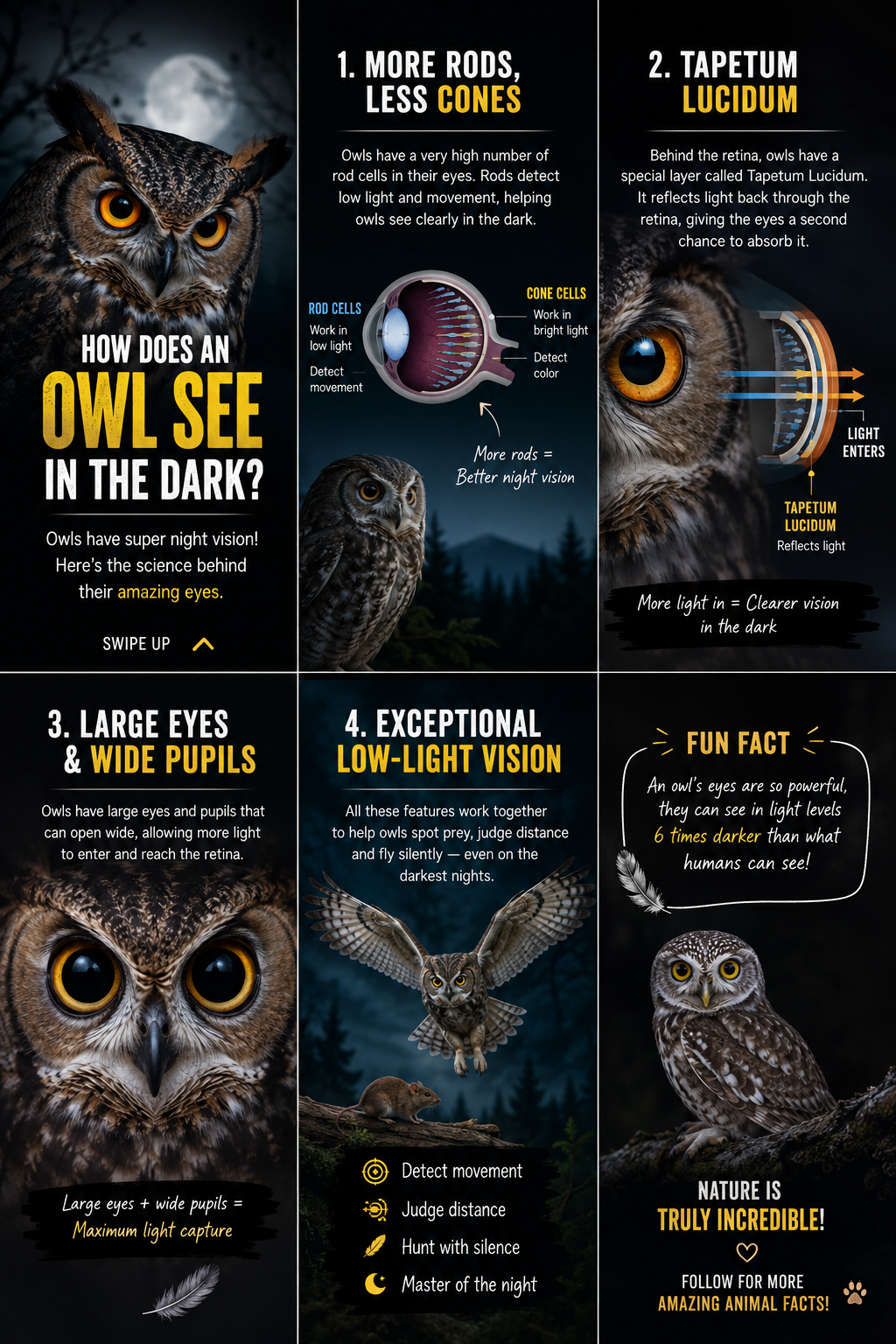
How Does an Owl See in the Dark?

How Does an Owl See in the Dark? | The Secret Behind Seeing in the Dark! 🌙 Amazing Owl Facts for Kids

🦉 Have you ever wondered how an owl can fly through the night and find its food in almost complete darkness? Owls are some of nature’s most amazing nighttime hunters. Their special eyes and senses help them see and hunt when most other animals are asleep.

Let’s explore the fascinating world of owl night vision and discover how these incredible birds see in the dark!

Why Are Owls Active At Night?

Most owls are nocturnal animals, which means they are awake and active during the night. They spend their evenings searching for food such as mice, insects, frogs, and small birds.

Since it is dark at night, owls need special abilities to help them find their prey. One of their greatest superpowers is their amazing night vision.

Do Owls Really See in Complete Darkness?

Not exactly!

Owls cannot see in total darkness where there is absolutely no light. However, they can see extremely well in very low light conditions, such as moonlight, starlight, or twilight.

Their eyes are specially designed to gather and use even the tiniest amount of available light.

What Makes Owl Eyes So Special?

1. Large Eyes Collect More Light

An owl’s eyes are very large compared to the size of its head.

The larger the eye, the more light it can collect. This helps owls see clearly when it is dark outside.

Imagine using a bigger flashlight to brighten a dark room. Owl eyes work in a similar way by gathering more light.

2. More Rod Cells for Night Vision

Inside the eye are special cells called rods and cones.

  • Rod cells help animals see in low light.
  • Cone cells help animals see colors.

Owls have many more rod cells than humans. This allows them to detect movement and shapes in dim light much better than we can.

3. Forward-Facing Eyes

Unlike many birds, owl eyes face forward.

This gives owls excellent binocular vision, which helps them judge distances accurately. Knowing exactly how far away their prey is helps them make successful hunts.

4. Large Pupils

The pupils of an owl can open very wide.

Large pupils allow more light to enter the eye, helping the owl see better at night.

 Can Owls Move Their Eyes?

Surprisingly, no!

An owl’s eyes are shaped more like tubes than round balls. Because of this unusual shape, their eyes cannot move around in their sockets.

Instead, owls can turn their heads up to 270 degrees to look in different directions.

This gives them a very wide view of their surroundings.

Owls Also Have Amazing Hearing

Seeing in the dark is only part of the owl’s secret.

Owls have incredibly sharp hearing that helps them locate prey hidden under leaves, grass, or even snow.

Some owl species can hear the tiny movements of a mouse and catch it without even seeing it clearly.

Their combination of excellent hearing and night vision makes them expert hunters.

How Do Owls Hunt at Night?

Here’s how an owl catches its prey:

The owl quietly flies through the night.
Its large eyes gather available light.
Its sensitive ears listen for sounds.
It spots or hears its prey.
It swoops down silently and catches it with sharp talons.

Their soft feathers also help them fly almost silently, making it harder for prey to hear them coming.

Fun Owl Facts For Kids 🦉
🌙 Owls can see much better than humans in low light.
🦉 There are more than 250 species of owls around the world.
👂 Some owls can hear sounds from several feet away, even under snow.
🌳 Owls live in forests, deserts, grasslands, mountains, and cities.
🪶 Their feathers help them fly quietly through the night.
👀 Owl eyes are so large that they take up a significant part of their skull.


Why Are Owls Important?

Owls help keep nature balanced by controlling populations of mice, rats, and insects. They play an important role in ecosystems and help farmers by reducing crop-damaging pests.

Protecting owl habitats helps keep these wonderful birds safe for future generations.

Conclusion

Owls are incredible nighttime birds with special adaptations that help them see in the dark. Their large eyes, extra rod cells, wide pupils, and excellent hearing allow them to hunt successfully at night.

The next time you hear an owl hooting after sunset, remember that its amazing night vision is helping it explore the darkness with ease!

error: Content is protected !!